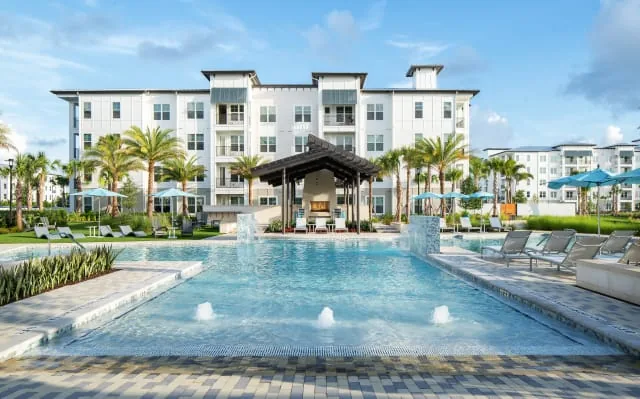
CF Westshore Multifamily DST Overview
CF Westshore Multifamily DST (sponsored by Cantor Fitzgerald Investors in a joint venture with RPM Living) owns The Residences at Westshore Marina, a 351-unit, 2019-vintage Class A apartment community at 5350 Bridge Street, Tampa, FL 33611, within the 52-acre waterfront Westshore Marina District roughly seven miles southwest of downtown Tampa. The asset sits on 12.07 acres with 570 parking spaces (47 attached and 30 detached garages) and a unit mix of 128 one-bedroom (803 SF), 182 two-bedroom (1,251 SF), and 41 three-bedroom (1,432 SF) units averaging 1,109 SF, with Class A interiors and resort-style amenities. It was 93.7% occupied at a $2,602 average rent as of the September 15, 2025 rent roll, with trailing-30-day new leases at $2,759 (6.0% above in-place) and 94.2% average occupancy since 2020. The Trust acquired the Property for $125,550,000 and capitalized the transaction at a $142,736,000 total offering, comprising $64,000,000 of equity and a $78,736,000 Berkeley Point Capital d/b/a Newmark (Freddie Mac) first mortgage fixed at 4.93%, interest-only for the full seven-year term to a November 1, 2032 maturity (55.16% loan-to-offering price). A light value-add program targets wood-inspired vinyl flooring in approximately 158 units (~$59/month premium) plus exterior, amenity, and landscaping upgrades. The Property is net-leased to an affiliated Master Tenant capitalized with $1,250,000 (including a $750,000 demand note), and the Business Plan targets a sale prior to the loan maturity over an approximately seven-year hold, with targeted cash-on-cash rising from 4.25% to 5.03%; RPM Living (the fourth-largest U.S. multifamily manager, 230,000-plus units) operates the asset. Securities offered through Cantor Fitzgerald & Co.
Highlights
The Property is a 2019-vintage Class A community that is already stabilized, 93.7% occupied at a $2,602 average rent with 94.2% average occupancy since 2020 and trailing-30-day new leases at $2,759, roughly 6.0% above in-place rents, signaling embedded loss-to-lease. High-end interiors (stainless appliances, quartz, kitchen islands, smart-home technology, in-unit laundry, and select private attached garages) and a deep amenity package position the asset competitively without the lease-up risk of a recent delivery.
A defined value-add program provides modest internal growth: installation of wood-inspired vinyl flooring in approximately 158 of the 351 units is underwritten to drive an average ~$59/month rent premium per renovated unit, supplemented by exterior, amenity, and landscaping enhancements. The program is incremental rather than a heavy repositioning, consistent with a stabilized asset and the projected step-up in cash-on-cash from 4.25% to 5.03% over the hold.
The Property anchors the 52-acre master-planned Westshore Marina District on the Tampa Bay waterfront, offering direct walkability to a marina, boutique retail, dining, and 1.5 miles of waterfront, with connectivity via I-275, the Selmon Expressway, and the Veterans Expressway. It sits within a 15-minute drive of the Westshore Business District (Tampa's largest office submarket, with 6,500-plus businesses and 100,000-plus employees), downtown Tampa, the Gateway market, downtown St. Petersburg, and Tampa International Airport, and within a five-mile radius averaging $160,182 household income and $739,198 home values.
Financing is a $78,736,000 Berkeley Point Capital d/b/a Newmark first mortgage executed through the Freddie Mac Capital Markets program, fixed at 4.93% and interest-only for the full seven-year term to a November 1, 2032 maturity at a 55.16% loan-to-offering-price ratio. The below-market fixed coupon (favorable versus the 2025 rate environment) and full-term interest-only structure maximize current distributable cash and support roughly 1.86x Year 1 NOI-to-debt-service coverage, while leaving the full balance to balloon at maturity with the business plan calling for a sale before that date.
The offering pairs an institutional sponsor with a top-tier operator: Cantor Fitzgerald (founded 1945, investment-grade rated by Standard & Poor's and Fitch, a Federal Reserve primary dealer, and roughly $87 billion of 2024 real estate transactions) in a joint venture with RPM Living, the fourth-largest U.S. multifamily manager with more than 230,000 units under management, including approximately 4,336 units across the Tampa MSA, providing local operating density.
Analysis of CF Westshore Multifamily DST
Insights
In portfolio terms this is a bond-like Core-Plus multifamily holding — a stabilized 2019-vintage Class A asset with a light value-add overlay — where the investor is buying a modestly growing income stream and, above all, an exit bet on 2032 Tampa pricing rather than a leveraged growth story. The relative-value read is honest but unspectacular: the ~4.53% average cash-on-cash roughly meets the multifamily market on income, yet both the 5.03% peak yield and projected growth screen below the sector average — a below-benchmark yield ceiling accepted for above-benchmark asset quality and location. The ~13.25% load is heavy (including a 4.90%-of-equity acquisition fee) and must be earned back over a compressed seven-year hold; and while debt-service coverage is comfortable near 1.86x, the Year-1 distribution runs ahead of the asset's covered cash flow (payout ratio near 1.49), so the headline 4.25% leans partly on the master-lease structure and reserves rather than being fully organic. With a 4.93% fixed cost of debt against a full going-in basis, positive leverage is thin, so the 4.25%-to-5.03% ramp is carried by rent growth and loss-to-lease capture, not financial engineering. The crux is the exit: the interest-only Freddie Mac loan balloons November 1, 2032, the master lease and forecast end at the same point, and prepayment lockout plus defeasance leave little room to wait out a weak tape, so the 2032 terminal cap rate and refinancing environment dominate the IRR. Notably, Cantor's nine full-cycle deals averaged a 1.45x multiple over a ~3.9-year hold, whereas here income alone supplies only ~32% over seven years, so the exit must furnish most of any comparable multiple — a longer, more exit-dependent bet than the realized record. Genuine supports — Westshore waterfront positioning, Tampa in-migration, 55% leverage, a below-market coupon, RPM Living — cushion but do not drive returns. This suits an accredited 1031 investor wanting durable Class A Sun Belt income who can hold to a hard 2032 exit and accepts a below-sector yield ceiling for quality; it is a poor fit for anyone needing higher current yield, timing flexibility if the 2032 window is weak, or a 721/UPREIT roll-up, since the stated exit is an outright sale and cash distribution.
Advantages
On a micro level, the offering is a stabilized, 2019-vintage Class A multifamily asset (93.7% occupied, 94.2% average occupancy since 2020) in a high-income waterfront submarket, with trailing new leases roughly 6.0% above in-place rents indicating capturable loss-to-lease and a defined, low-intensity value-add program (~158 units of flooring upgrades at ~$59/month premiums plus amenity and exterior work). Tampa fundamentals are supportive: South Tampa effective rents are forecast to grow ~3.1% annually through 2028, three-mile population growth is projected near 1.9% annually (well above the national average), and the Westshore submarket is the region's largest employment hub with major redevelopment underway. On a macro and structural level, the capital stack is conservatively levered at 55.16% with a fixed 4.93%, full-term interest-only Freddie Mac loan that insulates against rate volatility and supports ~1.86x Year 1 coverage and a 4.25%-to-5.03% distribution ramp, and execution is backed by an investment-grade-rated institutional sponsor (Cantor Fitzgerald) paired with the fourth-largest U.S. multifamily operator (RPM Living) with deep Tampa-market density.
Concerns
Asset-specific vulnerabilities cluster around the loan maturity, the income waterfall, and a single-asset, single-market profile. The $78,736,000 loan is interest-only with no amortization and balloons at the November 1, 2032 maturity, and because the master lease and forecast both run only about seven years, the entire return depends on selling or refinancing into the prevailing pricing and rate environment at that point; prepayment lockout and defeasance provisions further constrain exit-timing flexibility. Distributions flow through an affiliated, thinly capitalized Master Tenant (about $1,250,000 of capitalization, including a $750,000 demand note) that may defer rent, and the targeted return is partly contingent: Base Rent covers debt service and uncontrollable expenses, while investor cash flow above roughly 4.15% relies on capped Additional Rent and performance-based Bonus Rent that builds late in the hold. The asset is a single property in one Tampa submarket, exposing it to localized supply (the forecast itself assumes a 6.5% vacancy factor, with South Tampa vacancy near 5.7%-6.8% in 2026-2027) and to Florida-specific insurance cost pressure, which the underwriting carries as a sizable and growing expense line. The going-in basis is full, leaving thin initial positive leverage, and the ~13.25% upfront load, including a 4.90%-of-equity acquisition fee, is relatively high and must be earned back over a comparatively short seven-year hold.
CF Westshore Multifamily DST — Complete Offering Data
Offering & Structure
Investment NameCF Westshore Multifamily DST
SponsorCantor Fitzgerald
StructureDelaware Statutory Trust (DST)
Offering Type506(b)
StatusClosed
Last Updated2026-08-05
Size & Availability
Total Offering$142,736,000
Equity$64,000,000
Debt$78,736,000
Available Equity$0 (0% of equity)
Minimum Investment$100,000
Total Load13.25%
Initial Reserves5.06%
Property
Property TypeMultifamily
StrategyCore-Plus
LocationFL
Market TierTier 1
Income & Projections
Average Yield4.53%
Projected Yields (Y1–Y10)Y1 4.25% · Y2 4.25% · Y3 4.31% · Y4 4.35% · Y5 4.61% · Y6 4.88% · Y7 5.03%
Tax-Adjusted Yield5.90%
Cap Rate Equivalent8.50%
Year 1 NOI$7,933,281
Y1 Payout Ratio1.49
Financing
In-Place LTV55.16% LTV
LenderBerkeley Point Capital LLC d/b/a Newmark (Freddie Mac)
Loan TypeFixed
Interest Rate4.93% (Fixed)
Loan Term7 years
I/O Period7 years
AmortizationN/A (interest-only)
Y1 DSCR1.86x
Exit
Estimated Hold Period5-7 years
721 Exchange ExitNone
Benchmarks (vs sector median)
Avg. Income4.53% vs 4.85% market — Meets Average
Growth18.35% vs 24.88% market — Below Average
Peak5.03% vs 5.55% market — Below Average
Every data point Baker 1031 tracks for this offering, in one place. Figures are drawn from the offering’s private placement memorandum and sponsor materials unless noted, are summaries for convenience only, and are qualified in their entirety by the PPM. Tap the ⓘ icon next to any label for what it means and how it is calculated.