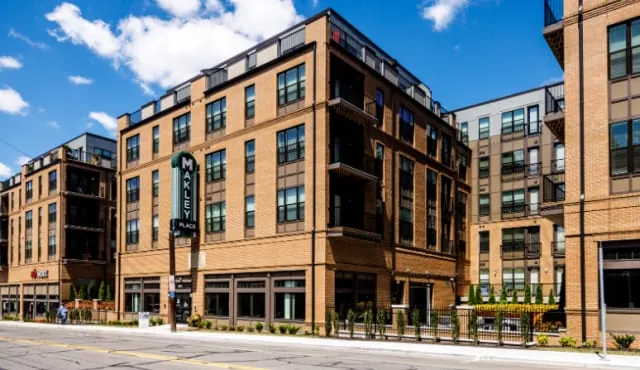
Starboard Makley DST Overview
Makley Place is a recently delivered, six-story Class A mixed-use asset at 210 West 5th Avenue in Columbus, Ohio (43201), comprising 140 studio/one-/two-bedroom residential units across ~102,768 NRSF, three ground-floor commercial suites totaling ~6,128 NRSF, and 111 parking spaces on a 1.178-acre infill parcel; the amenity package (clubhouse, fitness center, business center, secured bicycle storage) targets the OSU-adjacent renter cohort. Sited ~2.5 miles north of the Columbus CBD and proximate to The Ohio State University (Franklin County's largest employer, with a ~$6.8B endowment), alongside the State of Ohio and JPMorgan Chase employment bases, the submarket draws on a deep, demographically resilient renter pool spanning university, healthcare, public-administration, and an expanding technology footprint (Battelle, regional semiconductor investment). The asset carries a City of Columbus Community Reinvestment Area agreement abating 100% of the assessed-value increment for 15 years from certificate of occupancy in exchange for 28 income-restricted units (14 at <=80% AMI, 14 at <=100% AMI). The operating thesis is stabilization-and-optimization: closing the ~260 bp gap between in-place (91.4%) and stabilized (94%) occupancy and layering two new ancillary revenue lines (a furnished corporate-rental program on five units via Landing/AMG and a Lloyd's-backed Resident Protection Plan netting ~$11/unit/month) under a Sponsor-affiliated master-lease structure financed with fixed-rate, interest-only Freddie Mac debt.
Highlights
The Community Reinvestment Area abatement is the single most consequential structural advantage: shielding 100% of the assessed-value increment from real property taxation for 15 years post-CO compresses the asset's largest non-controllable expense during the early-to-mid hold, evidenced by modeled property taxes holding near $49,000-$53,000 through Year 6 before stepping toward $163,000 by Year 10 as the benefit phases out. The 28-unit affordable set-aside (20% of unit count) is the consideration for that shield, but at <=80%/<=100% AMI bands in a supply-constrained, OSU-driven submarket the effective rent give-up is modest relative to the tax savings captured, producing an NOI uplift the Colliers appraisal explicitly capitalized into $3.75M of the $39.1M as-is value.
Submarket positioning rests on a quasi-captive demand base: proximity to a 1,764-acre OSU main campus with a large, perennially renewing student and graduate-employee population yields structurally low demand elasticity and durable absorption, while the intact, walkable urban fabric of near-north Columbus and constrained infill land supply elevate replacement-cost barriers to competing product. Franklin County's employer diversification across education, state government, healthcare, financial services (JPMorgan Chase), and a growing R&D/technology cluster (Battelle) dampens single-sector cyclicality, lending support to the 2.4%-3.0% forward rent-growth assumptions.
The financing is a defensive feature in the current rate regime: a $23,684,000 Freddie Mac Conventional Fixed Rate Program loan at a fixed 5.44% for the full ~10-year term (maturing September 1, 2035), fully interest-only with zero scheduled amortization, maximizes current distributable cash and eliminates the floating-rate and cap-renewal exposure that has impaired peer 2021-2023 vintage syndications. A $473,680 interest-rate buydown was funded at closing to achieve the coupon, and the Actual/360 convention is reflected in the ~$1.31M annual debt service, generating a Year 1 DSCR of 1.75x that expands to 2.10x by the terminal year as NOI grows against a static interest burden.
The three ground-floor commercial suites provide diversified, expense-recovering income, with tenants reimbursing their proportionate share of operating expenses, taxes, and maintenance, insulating residential cash flow from commercial cost inflation. Lease laddering is favorable: Kida House (1,945 SF) carries a long initial term to 6/30/2035 with escalations from $47,128 to $58,954 and three five-year renewal options, while Sweetly Bronzed (2,089 SF) runs to 10/31/2029 stepping to $46,906; the small commercial footprint (~6% of NRSF) limits retail-specific downside while preserving mixed-use placemaking value.
The Supplement-introduced revenue overlay is a low-capex margin enhancement: the Landing/AMG furnished corporate-rental program targets premium, higher-turnover rents on five units with limited owner capital outlay, supported by Columbus comparables generating $93,000-$105,000 of incremental owner revenue at four-to-five-unit deployments, while the Lloyd's-backed Resident Protection Plan converts a renters-insurance line into ~$11/unit/month of high-margin income with a damage-waiver benefit that also mitigates uncollected-damage leakage. Both initiatives front-load into Master Lease Year 1 with a true-up/special-distribution mechanic, accelerating the distribution ramp independent of base-rent growth.
Analysis of Starboard Makley DST
Insights
In portfolio terms this is a bond-proxy for tax-abated Class A apartment income - a stabilized-core multifamily asset in a DST wrapper, sensibly Core-Plus rather than Core given residual lease-up and unseasoned ancillary revenue, not a value-add play. On relative value it meets the category without beating it: the ~4.93% average and 5.77% peak distribution sit on the multifamily benchmark (income and peak-yield both screen Meets Average; only the back-loaded growth ramp screens Above Average), and Year-1 distributions are genuinely earned - a 0.95 payout ratio means they come from property NOI, not reserves or return of capital, which many DSTs of this vintage cannot say. The catch is entry cost: an 11.25% total load is heavy, and it buys a thin proposition - a Year-1 NOI yield near 6% on price against a 5.44% fixed cost of debt is a positive but slim going-in spread, so the load materially lengthens the path to breakeven. The crux is temporal and sits at the exit: returns are deliberately back-loaded (distributions ramping 4.52% to 5.77%, DSCR 1.75x to 2.10x) precisely as the CRA tax abatement decays and a 100% interest-only balloon matures in 2035 with no amortization cushion, so terminal value hangs almost entirely on the 2034-2035 cap-rate and refinancing environment - the one variable to watch. Two non-obvious cautions: the incremental Landing furnished-rental and resident-insurance income the upside case leans on is modeled from comparables, not yet demonstrated here, and the sponsor's own record is workmanlike - four full-cycle deals at a 1.35x average equity multiple over roughly six years - which argues against underwriting heroic execution. This suits a fee-simple 1031 exchanger who wants durable, tax-shielded current income from a conservatively financed, well-located apartment, accepts a mid-single-digit yield, and treats the optional, Trustee-discretionary Section 721 roll-up as a bonus rather than a plan. Investors reaching for total return, needing amortization to de-risk the exit, or unwilling to carry 2035 refinance risk on a low going-in spread should look elsewhere.
Advantages
On a micro level, the offering pairs a recently delivered, amenitized Class A asset in a high-barrier, OSU-anchored Columbus submarket with a 15-year CRA tax abatement that structurally suppresses the property's largest non-controllable expense and was directly capitalized into the third-party appraisal. The capital structure is conservative and rate-insulated (fixed 5.44% fully interest-only Freddie Mac debt for the full term with no amortization and no cap-renewal risk), producing a 1.75x going-in DSCR widening to 2.10x against a 52.64% debt-to-total-capitalization ratio. Income is diversified across 140 residential units and three expense-recovering commercial suites with laddered expirations, and the furnished-rental and resident-insurance programs add low-capex ancillary margin. Macro support includes Columbus's above-trend population growth, employer diversification across education, government, healthcare, finance, and an expanding technology base, and a prevailing market pricing that frames the in-place basis reasonably against comparable stabilized product.
Concerns
Asset-specific vulnerabilities concentrate around the abatement, the maturity, and the income waterfall. The CRA abatement burns off on a schedule that drives modeled property taxes from roughly $49,000 to $163,000 by Year 10 and ~$208,000 thereafter, compressing terminal NOI precisely as a sale or refinance must occur; the benefit is also conditional on continuous compliance with the 28-unit affordable set-aside, with a clawback of 20%-90% of abated tax payable to the City's Affordable Housing Trust on any shortfall. Because the loan is 100% interest-only with zero principal reduction, the entire $23,684,000 balloon matures 9/1/2035, concentrating refinance/disposition risk into an unknowable rate environment with no amortization cushion. The distribution profile depends on a multi-tier Additional Rent/Bonus Rent breakpoint waterfall routed through a thinly capitalized Sponsor-affiliated Master Tenant (where only 85% of cash above the bonus breakpoint accrues to the Trust) and lumpy DST CapX reserve draws (~$355,000 in Year 4, ~$303,000 in Year 7, ~$594,000 in Year 10) episodically depress distributable cash. Execution risk attaches to the unseasoned Landing/AMG program (36.5% management fee, early-termination fees up to $2,500/unit on sale, and platform fees payable while AMG units sit vacant) and to closing the ~260 bp lease-up gap to stabilized occupancy. The near-north Columbus pipeline of recently delivered Class A product (single comparables of 319,562 SF and 274,000 SF) pressures concessions and rent growth, and the Sweetly Bronzed commercial lease rolls mid-hold in 2029.
Starboard Makley DST — Complete Offering Data
Offering & Structure
Investment NameStarboard Makley DST
SponsorStarboard Realty Advisors
StructureDelaware Statutory Trust (DST)
Offering Type506(c)
StatusRejected
Last Updated2026-05-20
Size & Availability
Total Offering$44,994,000
Equity$21,310,000
Debt$23,684,000
Available Equity$11,744,530 (55.1% of equity)
Minimum Investment$100,000
Total Load11.25%
Initial Reserves10.24%
Property
Property TypeMultifamily
StrategyCore-Plus
LocationOH
Market TierTier 2
Income & Projections
Average Yield4.93%
Projected Yields (Y1–Y10)Y1 4.52% · Y2 4.61% · Y3 4.67% · Y4 4.50% · Y5 4.57% · Y6 4.77% · Y7 5.08% · Y8 5.30% · Y9 5.53% · Y10 5.77%
Tax-Adjusted Yield11.36%
Cap Rate Equivalent8.55%
Year 1 NOI$2,208,167
Y1 Payout Ratio0.95
Financing
In-Place LTV52.64% LTV
LenderBerkeley Point Capital LLC d/b/a Newmark
Loan TypeFixed
Interest Rate5.44% (Fixed)
Loan Term10 years
I/O Period10 years
AmortizationN/A (interest-only)
Y1 DSCR1.75x
Exit
Estimated Hold Period10 years
721 Exchange ExitOptional
Benchmarks (vs sector median)
Avg. Income4.93% vs 4.85% market — Meets Average
Growth27.65% vs 24.88% market — Above Average
Peak5.77% vs 5.55% market — Meets Average
Every data point Baker 1031 tracks for this offering, in one place. Figures are drawn from the offering’s private placement memorandum and sponsor materials unless noted, are summaries for convenience only, and are qualified in their entirety by the PPM. Tap the ⓘ icon next to any label for what it means and how it is calculated.