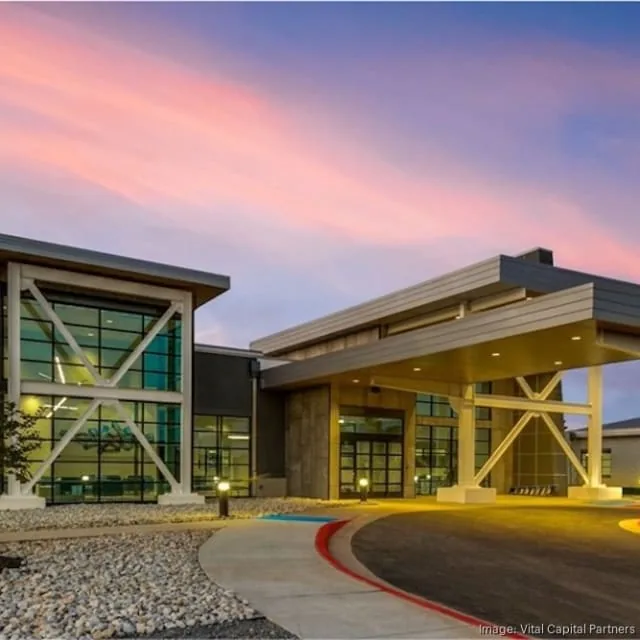
Vital Capital Medical - Temple TX DST Overview
Vital Capital Medical - Temple TX DST is a single-tenant, net-leased healthcare Delaware Statutory Trust holding the Temple Rehabilitation Hospital, a 36-bed inpatient rehabilitation facility of approximately 38,817 SF on a ~6-acre site at 23621 SE H K Dodgen, Temple, Texas (Killeen-Temple MSA, on the I-35 corridor between Austin and Waco). Built in 2018, the purpose-built hospital treats stroke, brain-injury, neurological, orthopedic, and cardiac rehabilitation patients. The Trust master-leases the Property to a Sponsor-affiliate Master Tenant, which has assumed an absolute-net sublease to the operating tenant, CRH of Temple, LLC, an unaffiliated operator whose parent is Lifepoint Health (rated B by S&P and B2 by Moody's), with roughly 7.5 years of term remaining and three 5-year extension options. The Trust acquired the Property on November 25, 2025 from Community Healthcare Trust (CHCT Texas, LLC) for a $29,695,000 purchase price (against a $29,750,000 CBRE appraisal), capitalized within a $34,551,889 total investment cost of $15,958,139 equity and an $18,593,750 First Horizon Bank loan (5.65% effective fixed via swap; seven-year term maturing November 2032; interest-only for four years then 25-year amortization), a 53.81% loan-to-cost. The forecast targets a 7.32% Year-1 cash-on-cash building to 7.91% by Year 4 before amortization begins, averaging 7.28% over a seven-year hold, with a discretionary 721 UPREIT exit.
Highlights
Income depends on a single healthcare operator, CRH of Temple, LLC, whose parent is Lifepoint Health, rated B by S&P and B2 by Moody's. This is a speculative, non-investment-grade credit, so the roughly 7.3% projected yield is in substantial part compensation for operator-credit and healthcare-reimbursement risk rather than a low-risk coupon, and a Lifepoint or operating-tenant distress event would directly impair the Trust's rent.
The asset is a 2018-built, purpose-built 36-bed inpatient rehabilitation hospital, a highly specialized single-use facility serving stroke, brain-injury, and neurological rehabilitation. Specialization supports the operator's clinical franchise and switching costs, but it sharply limits alternative use: if the operator vacates or fails, re-leasing to another licensed inpatient-rehab operator would be costly and slow, and residual value is tightly tied to continued healthcare use.
The Property is held on an absolute-net basis through a master-lease/sublease structure, with the Sponsor-affiliate Master Tenant interposed between the Trust and the third-party operating tenant; the operating tenant bears taxes, insurance, and maintenance and holds three 5-year renewal options. With only ~7.5 years of remaining term against a seven-year hold, the disposition coincides with meaningful term burn-off, so exit value depends on a renewal or a buyer underwriting re-leasing risk on a short-dated, single-tenant medical asset.
Located in the Temple Medical District along the I-35 corridor between Austin and Waco within the growing Killeen-Temple MSA, the hospital benefits from a deep regional healthcare employment base (Temple is a major medical hub) and demographic tailwinds supporting inpatient-rehab demand. The location supports the operator's patient catchment, though the investment's performance remains tied to that single operator rather than to broad market dynamics.
The acquisition was financed with an $18,593,750 First Horizon Bank loan swapped to a 5.65% effective fixed rate, interest-only for four years and then amortizing over 25 years through a November 2032 maturity, producing a strong early DSCR (2.24x) that steps down toward ~1.94x when principal payments begin in Year 5. The acquisition was partly funded by ~$11.5M of Sponsor and MBRE preferred bridge equity to be redeemed by offering proceeds, so the structure carries bridge-carry cost and reliance on full syndication, alongside customary affiliate conflicts.
Analysis of Vital Capital Medical - Temple TX DST
Insights
Read this as a high-yield credit position on one below-investment-grade hospital operator, dressed as net-lease real estate: the 7.32% is rent from a B/B2 tenant, not a coupon off the bricks. The income screens Above Average - 7.32% Year-1 cash-on-cash building to a 7.91% Year-4 peak, averaging 7.28% over the seven-year hold against a ~6.4% healthcare net-lease benchmark, peak Above Average too - but growth screens Below Average, so it's an income play, and ~90 bps over benchmark is thin pay for swapping ordinary net-lease credit for one speculative-grade operator on a single-use asset. The load is heavy at 10.63%, well past the ~7% that reads clean, for an unusual reason: ~$11.5M of proceeds redeems Sponsor/MBRE preferred bridge equity rather than buying building, so subscribers partly fund the sponsor's exit. One figure the deck underplays cuts the other way: the Year-1 payout is covered by property NOI (payout ratio 1.11, above the 1.0 line), so the distribution is real income, not return of capital, and the Year-5 dip to 6.63% is amortization building equity after the four-year interest-only window, not a coverage miss. The crux is operator against calendar: rent runs from CRH of Temple, parent Lifepoint Health rated B/B2, into a 36-bed rehab hospital with ~7.5 years of term left against a seven-year hold, the loan ballooning November 2032 alongside the exit. Watch operator solvency, inpatient-rehab reimbursement, and the renewal call: terminal value hinges on an extension or a buyer for short-dated single-tenant medical credit, and ~54% leverage flatters the 2.24x DSCR while sharpening balloon risk. Own it if you're an income-focused 1031 investor already holding diversified DSTs, at ease with single-operator healthcare credit and choosing yield over appreciation; pass if you need investment-grade safety, want growth, or would read 7.3% as a bond-proxy coupon.
Advantages
The offering delivers an above-average projected income stream (7.32% Year-1 cash-on-cash building to 7.91% by Year 4, averaging 7.28% over the seven-year hold) from a modern, 2018-built, 100%-leased inpatient rehabilitation hospital on an absolute-net lease, with the operating tenant responsible for taxes, insurance, and maintenance and holding three 5-year renewal options. The asset sits in the Temple Medical District along the high-traffic I-35 corridor within the growing Killeen-Temple MSA, a genuine regional healthcare hub, and was acquired at essentially its appraised value with moderate leverage (53.81% loan-to-cost) on a 5.65% swapped fixed-rate loan that is interest-only for four years, supporting a strong early DSCR of 2.24x. A discretionary 721 UPREIT exit offers a potential pathway to REIT-unit liquidity and diversification.
Concerns
The income rests on a single operator of a single special-purpose asset, and the operator's parent, Lifepoint Health, carries speculative-grade ratings (B/B2), so the elevated yield is materially a credit-risk premium and a Lifepoint or operating-tenant distress event would directly threaten the rent. The 36-bed inpatient rehabilitation hospital is a highly specialized facility with limited alternative use, creating substantial re-leasing cost and downtime risk, and with only ~7.5 years of remaining lease term against a seven-year hold the planned exit coincides with significant term burn-off, leaving terminal value dependent on a renewal or a buyer willing to underwrite short-dated single-tenant medical risk. The structure interposes a Sponsor-affiliate master tenant between the Trust and the third-party operating tenant and was funded in part by roughly $11.5 million of Sponsor and MBRE preferred bridge equity redeemed by offering proceeds, importing bridge-carry cost, reliance on full syndication, and affiliate conflicts. Leverage of 53.81% loan-to-cost amortizes after a four-year interest-only period, stepping the cash-on-cash down from 7.91% in Year 4 to 6.63% in Year 5, and the loan matures in November 2032 concurrent with the hold, concentrating refinancing or forced-sale risk; healthcare reimbursement and regulatory shifts affecting inpatient-rehab economics are an additional exogenous risk to the operator's rent coverage.
Vital Capital Medical - Temple TX DST — Complete Offering Data
Offering & Structure
Investment NameVital Capital Medical - Temple TX DST
SponsorHPA Exchange
StructureDelaware Statutory Trust (DST)
Offering Type506(c)
StatusClosed
Size & Availability
Total Offering$34,551,889
Equity$15,958,139
Debt$18,593,750
Available Equity$0 (0% of equity)
Minimum Investment$50,000
Total Load10.63%
Initial Reserves6.48%
Property
Property TypeHealthcare
StrategyCore-Plus
LocationTX
Market TierTier 3
Income & Projections
Average Yield7.28%
Projected Yields (Y1–Y10)Y1 7.32% · Y2 7.50% · Y3 7.69% · Y4 7.91% · Y5 6.63% · Y6 6.84% · Y7 7.05%
Tax-Adjusted Yield7.00%
Cap Rate Equivalent9.94%
Year 1 NOI$2,349,199
Y1 Payout Ratio1.11
Financing
In-Place LTV53.81% LTV
LenderFirst Horizon Bank
Loan TypeFixed
Interest Rate5.65% (Fixed)
Loan Term7 years
I/O Period4 years
Amortization25 years
Y1 DSCR2.24x
Exit
Estimated Hold Period7 years
721 Exchange ExitOptional
Benchmarks (vs sector median)
Avg. Income7.28% vs 6.41% market — Above Average
Growth8.06% vs 15.43% market — Below Average
Peak7.91% vs 7.03% market — Above Average
Every data point Baker 1031 tracks for this offering, in one place. Figures are drawn from the offering’s private placement memorandum and sponsor materials unless noted, are summaries for convenience only, and are qualified in their entirety by the PPM. Tap the ⓘ icon next to any label for what it means and how it is calculated.